Building Bharat’s Brain: Why sovereign Indian LLMs are critical for cost, control and cultural context
At the ET EnterpriseAl Agentic Summit 2026, leaders from BharatGen Technology and Reliance Jio outline why India must build its own large language models to ensure affordability, linguistic accuracy and long-term digital sovereignty.
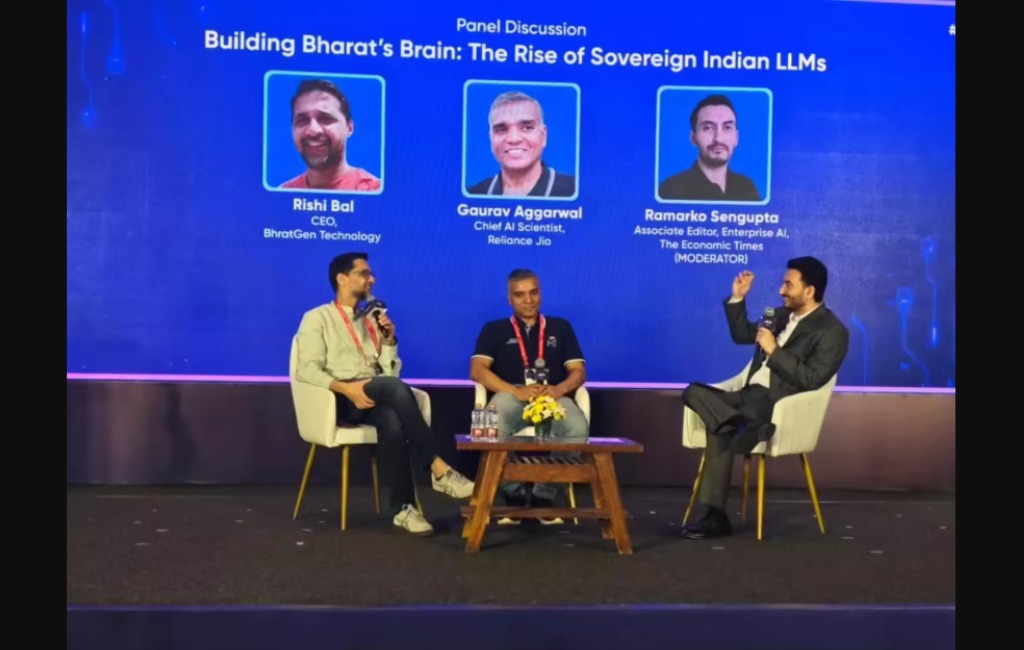
Alt: At the ET EnterpriseAl Agentic Summit 2026, experts discussed building sovereign Indian Al models to power a homegrown ‘Bharat’s Brain’ stack.
As nations race to define their Al futures, India’s ambition is becoming clearer: move from being a consumer of global Al models to a creator of sovereign intelligence. At the ET EnterpriseAl Agentic Summit 2026, Rishi Bal, CEO, BharatGen Technology and Gaurav Aggarwal, Chief Al Scientist, Reliance Jio, joined to discuss what it will take to build “Bharat’s Brain”-a stack of Indian-controlled large language models (LLMs) tailored to the country’s scale and complexity.
Bal framed the challenge through three lenses: sovereignty, Indianness and accessibility. “India will likely have a voice-first future,” he noted, arguing that models must be built with Indian languages, accents and cultural context at their core—not as afterthoughts. Beyond cultural nuance, cost remains a structural barrier. Enterprises cannot sustainably run Al services if inference costs remain high, particularly when Indian languages require significantly more processing tokens than English. The result is a compounded economic disadvantage for local adoption.
Aggarwal explained why this inefficiency exists. Many foundational models have not been sufficiently exposed to Indian languages during training. As a result, representing Indian scripts through Western tokenization systems introduces overhead and computational inefficiencies. “It’s like teaching a child a language they were never exposed to early on—the subtleties are harder to grasp,” he suggested, drawing an analogy to linguistic development. The technical challenge, therefore, is not merely about translation but about native understanding -speech, inflection, dialect and context. Without that foundation, enterprises face higher processing costs and lower accuracy in customer- facing applications such as voice bots and service automation.
The discussion also broadened the idea of sovereignty beyond model weights. For Aggarwal, true sovereignty spans the entire stack-from applications and model training to data centers and silicon. “Sovereignty doesn’t mean not participating in the global marketplace,” he clarified. “It means having control over your destiny.” As India rises among the world’s largest economies, the question is not whether it can build, but how far down the Al stack it is willing to invest-from compute infrastructure to domain-specific models that serve national priorities.
Both speakers emphasised that underserved domains represent another compelling case for indigenous LLMs. Global black-box models may perform well in financial or generic use cases but often lack depth in sectors critical to India, such as agriculture, regional governance and public services. Purpose-built Indian models can close that gap while embedding privacy-preserving data collaboration frameworks aligned with domestic regulations.
Looking ahead, the panel predicted tangible progress within the next 12 months. Enterprises can expect to see more cost-efficient, India-tuned models entering production environments. Bal projected a shift in adoption patterns as Indian companies begin deploying local LLMs at scale. Aggarwal added that globally competitive models originating from India are likely to emerge soon, signaling not just self-reliance but export capability.
The session concluded with a forward-looking assertion: building sovereign LLMs is not about technological nationalism-it is about economic pragmatism, linguistic inclusion and strategic resilience. For India to fully realise its Al opportunity, it must move beyond adaptation and invest in foundational capabilities. Bharat’s brain, the panel suggested, will not be imported-it will be built.
Source: ET EnterpriseAI