Building India’s AI Future: Rishi Bal on Sovereign AI Talent & Innovation | BharatGen
When Passion Meets Purpose: The Story Behind This Historic Tech Summit
On September 22, 2025, India’s tech ecosystem witnessed a pivotal conversation that few will forget. In a packed auditorium that embodied the spirit of innovation and collaboration, four visionary leaders gathered to discuss one of the most critical challenges facing modern India: how to build sovereign, resilient technological capabilities that can compete globally while serving domestic needs.
What made this panel particularly unique was a striking observation made at the outset: of the four distinguished panelists—Shashi Shekhar Vempati (Co-Founder, DeepTech for Bharat Foundation), Vivek Mishra (Co-Founder & CEO, Raphe mPhibr), and Rishi Bal (Executive Vice President, BharatGen)—three had studied abroad and deliberately returned to India to build here. This wasn’t a coincidence or a passing trend. It was a powerful statement about India’s emerging magnetism as a destination for deep tech innovation.
The title “Frontier Tech for Bharat: Building Deep Capabilities for a Sovereign Future” set the stage for an unflinching discussion about how India can achieve tech sovereignty—a concept that has become increasingly urgent in our geopolitically volatile world.
Rishi Bal’s Vision: From AI Consumer to AI Creator
Positioned at the intersection of academia and industry, Rishi Bal brought a unique vantage point to the conversation. Having worked at Google Research during the transformer revolution—arguably the most critical moment in modern AI history—Rishi’s decision to return to India and lead BharatGen represents a fundamental shift in how India’s tech talent thinks about career trajectories and national contribution.
The Challenge and the Opportunity
When asked about the challenges India faces in building foundational AI models, Rishi offered a refreshingly honest yet optimistic perspective. He acknowledged that India faces “enormous” challenges—particularly in two critical areas: data and talent. However, he pivoted immediately to a crucial insight that distinguishes his approach from purely pessimistic narratives:
“The good news for us is that everyone else around the world faces the same set of challenges.”
This isn’t dismissiveness. It’s strategic clarity. Rishi pointed out that only a handful of countries worldwide possess the talent density needed to produce LLMs (Large Language Models) at scale, and similarly, only a handful have sufficient high-quality data. By framing this as a shared global challenge rather than India’s unique weakness, Rishi repositioned the conversation: India’s opportunity isn’t to overcome an insurmountable gap, but to solve a problem that the world is collectively grappling with.
More provocatively, he suggested that if India can solve these challenges effectively, it could become not just a provider of AI for India, but a global AI producer—exporting both models and the talent that builds them.
Alt: At CNN-News18’s Frontier Tech for Bharat panel, Rishi Bal shares how BharatGen is shaping India’s AI future through sovereign AI talent, foundational models, and deep-tech innovation.
The BharatGen Model: Where Academia Meets Industry
The real substance of Rishi’s contribution to this summit emerged when he described how BharatGen operates—a model that directly addresses India’s most pressing AI talent challenge.
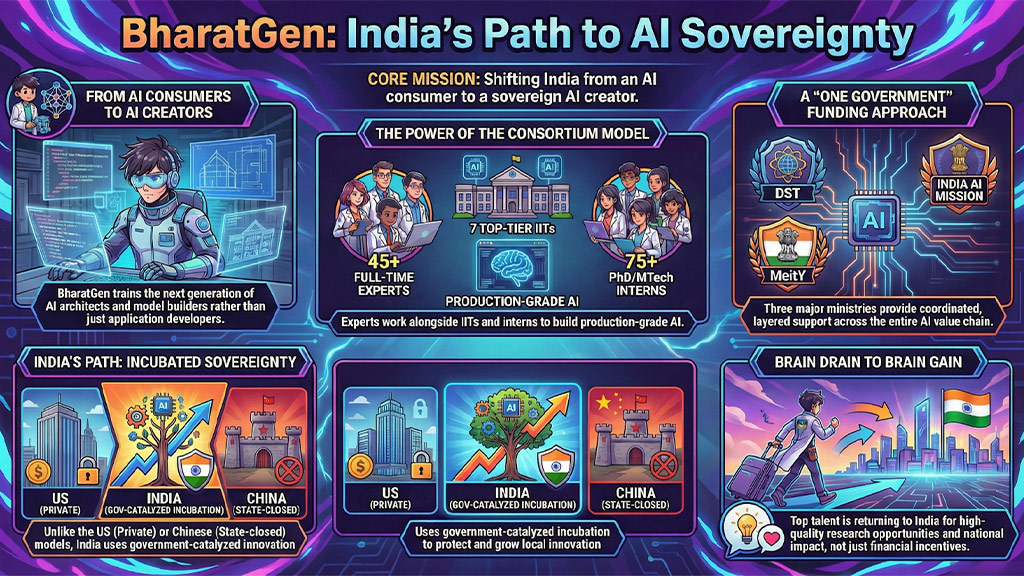
Rather than choosing between a purely academic route or a purely industrial one, BharatGen created a consortium-based approach. Here’s how it works:
Organizational Structure
- Section 8 nonprofit foundation that operates with the agility and efficiency of a for-profit company
- 45+ full-time employees building the core AI and product teams
- 7 academic partners from India’s top institutions:
- IIT Bombay
- IIT Madras
- IIT Kanpur
- IIT Mandi
- IIT Hyderabad
- IIT Hyderabad
- IIM Indore
- 75+ B. Tech, M. Tech and PhD interns from these institutions embedded within the engineering teams
The Innovation: Creating AI Creators, Not AI Consumers
What distinguishes this model from traditional university partnerships or startup ecosystems is Rishi’s explicit philosophy: creating AI creators, not just AI consumers or application builders.
This is a subtle but profound distinction. In most of India’s tech landscape, AI adoption has meant training engineers to build applications on top of AI models created elsewhere. What BharatGen is doing is fundamentally different—it’s creating the next generation of AI architects, model builders, and finetuners who understand the foundations of these systems and can innovate at the deepest levels.
By embedding 75+ high-potential PhD and MTech students directly into the engineering workflow alongside full-time researchers, BharatGen is doing something that universities alone cannot: it’s creating a talent production assembly line where academic rigor meets industry-grade execution. Students graduate not just with published papers, but with production experience, systems-thinking skills, and the collaborative instincts needed to scale AI products.
The Broader Context: Tech Sovereignty and India’s AI Strategy
What is Tech Sovereignty?
Shashi Shekhar Vempati opened the summit by defining “tech sovereignty”—a concept that extended far beyond the nationalist “Swadeshi” rhetoric. Sovereignty, as he framed it, isn’t about building everything in India for its own sake. It’s about strategic resilience and independence in critical technologies.
He anchored this concept in recent history: COVID-19 revealed India’s foresight in creating sovereign platforms like UPI and DD Freedish. When lockdowns disrupted global supply chains and internet-dependent systems, these platforms enabled financial continuity and educational delivery despite infrastructure constraints. Today, with semiconductor supply chains concentrated in single countries and AI models carrying cultural biases from their origins, tech sovereignty isn’t optional—it’s existential.
India’s Position in Global AI
India holds roughly 20% of global semiconductor design talent—a staggering concentration of human capital in a critical field. Yet, as multiple panelists noted, India’s role in the global AI ecosystem has historically been limited to services: building applications, tuning models created elsewhere, and providing data annotation. What India lacked was the indigenous capability to build foundational models and own the AI IP that powers them.
This is where BharatGen’s mission becomes strategically important. By developing India’s first domestically-built foundational AI models, combined with a talent pipeline that creates “AI creators,” Rishi and his team are directly addressing this gap.
Government Support: A “One Government” Approach
One of the most encouraging insights Rishi shared was about the changing relationship between India’s tech startups and the Indian government. He described experiencing a “positive one government approach”—a marked shift from historical silos and overlapping jurisdictions.
Coordinated Multi-Ministry Funding
The funding support for BharatGen came from: – Department of Science and Technology (seed funding) – India AI Mission (scalable funding) – Ministry of Information Technology (complementary support).
Rather than each ministry creating its own initiatives that competed or overlapped, they coordinated to support different layers of the AI ecosystem:
- Data infrastructure for AI training
- Talent institutes (the IITs and academic partnerships) churning out AI creators
- Model builders and finetuners to create foundational capabilities
- Application developers to commercialize AI
This “layered” approach, Rishi emphasized, is qualitatively different from how government funding historically worked in India. It’s not about having the most money; it’s about having coordinated, strategic deployment of resources across the entire value chain.
The Global Context: Three Models of AI Development
Rishi provided a sophisticated analysis of how different countries are approaching AI development, positioning India’s path within this landscape.
The American Model: Private Sector Dominance
Companies like Microsoft, Google, Meta and Amazon invest in AI using profits from other business lines. They enjoy massive scale due to: – Access to abundant capital – User bases that generate enormous amounts of training data – A risk-friendly venture capital ecosystem.
This model has produced the most advanced commercial AI systems but is concentrated among a few mega-corporations.
The Chinese Model: Government-Backed Closed Ecosystem
China provides significant government funding while maintaining a relatively closed domestic market. This allows: – Startups to thrive with protection from external competition – Long-term capital patience that Western markets may not afford – Strategic alignment with national objectives
The trade-off is reduced innovation from external diversity and potential inefficiencies from market insularity.
The Indian Path: Incubated Sovereignty
Rishi articulated a third way for India—one that doesn’t replicate either extreme but instead focuses on creating a durable, well-funded incubation environment. This means:
- Government catalyzing through strategic funding, not micromanaging.
- Policy incentives that encourage Indian startups and research entities to commit long-term to the Indian ecosystem
- Incubation spaces (both physical and institutional) that lower barriers to entry for AI innovators
- Competitive but collaborative frameworks (like consortia models) that allow Indian companies to compete globally without being crushed by subsidized foreign competitors
As Rishi noted with particular emphasis: “Money is not the challenge; the incubation environment and durable ecosystem support are.”
This distinction is crucial. It means India isn’t simply trying to out-spend Silicon Valley or match China’s subsidies. Instead, it’s building institutional and policy structures that make India a preferred destination for AI innovation—attracting talent, capital, and companies through the quality of the ecosystem rather than raw financial incentives alone.
The Talent Repatriation Challenge
Rishi spoke poignantly about a crisis in Indian science and academia: the “brain drain.” Out of 30 International Mathematical Olympiad finalists from India in a recent year, only 3-4 remained in India. Multiply this across all scientific disciplines, and the human capital loss becomes staggering.
Why Talent Leaves (And Why It Must Return)
When Rishi visited the US recently, he met approximately 150 Indian professors and PhD students who explicitly wanted to return to India. Yet they remained abroad. Why?
The answer isn’t simple, but Rishi identified the core issue: “If you bring people back and don’t give them the same quality of work they get there, that’s the challenge.”
Money, counterintuitively, wasn’t the primary barrier. Rather, it was: – Quality of research opportunities – Access to cutting-edge facilities and infrastructure – Peer networks and intellectual community – Career prospects and impact potential.
BharatGen’s Answer to Talent Retention
This is the psychological and structural innovation that may prove as important as the technical innovation BharatGen produces.
The Ecosystem Perspective: Thinking Beyond One Organization
While BharatGen is Rishi’s primary vehicle, he was careful to position it within a larger ecosystem thinking. His emphasis throughout was on how the entire Indian AI ecosystem can succeed, not just BharatGen’s growth.
This manifested in several ways:
Supporting the Academic Pipeline
By formally partnering with 7 IITs and creating incentive structures where industry participation counts toward academic evaluation (not just publications), Rishi is fundamentally reshaping how Indian academia thinks about its role. Rather than academia and industry being separate spheres, they become complementary partners in the mission to build India’s AI capabilities.
Policy and Incentive Structures
Rishi stressed the need for durable policy frameworks and incentives that encourage Indian startups, researchers, and companies to commit to building in India. Without these, the “sheer force of money” from subsidized international competitors will always pull talent and capital away.
The Incubation Gap
Perhaps most importantly, Rishi identified what he sees as the critical missing piece: incubation environments and institutional support that allow Indian AI startups and research entities to survive and thrive in their early, pre-commercial phases. This is where government and private sector patience becomes essential.
Rishi’s Role in the Larger Summit Narrative
The beauty of Rishi’s contribution was how it addressed the summit’s overarching theme while illustrating it concretely.
How It Connected to Tech Sovereignty
While Shashi Vempati framed tech sovereignty as a geopolitical and strategic imperative, Rishi showed how it becomes operational. Sovereignty isn’t achieved through announcements or policies alone; it’s built through: – Human capital development that creates genuinely skilled researchers and builders – Institutional models that blend academia and industry – Government-industry coordination that provides patient capital – Ecosystem thinking that recognizes no organization builds in isolation.
Contrasting with Defense Innovation
Vivek Mishra’s discussion of defence tech innovation highlighted the challenges of translating R&D into mass manufacturing and scale. While Rishi didn’t explicitly address manufacturing, his emphasis on creating a talent ecosystem at every layer suggests that once foundational models and IP are built, scaling talent for manufacturing and application development becomes the next frontier.
Complementing Semiconductor Progress
Mr. Luthra from the semiconductor industry noted that India holds 20% of global design talent but needs to translate that into manufacturing capability. Rishi’s point about creating “AI creators, not consumers” parallels this challenge: India must move from being a talent hub to being a capability hub—where innovations are conceived, matured, and commercialized domestically.
Key Takeaways from Rishi Bal’s Contribution
1. Shared Global Challenges, India’s Unique Opportunity
Talent and data challenges in AI aren’t India-specific; they’re global. By solving them well, India becomes a global player, not just a local one.
2. The Consortium Model as Scalable Solution
The BharatGen model—combining nonprofit governance with for-profit discipline, academic excellence with industry execution—offers a template for how India can rapidly scale AI talent and research.
3. Money is Not the Constraint
Government funding is necessary but insufficient. What India truly needs are incubation environments, policy incentives, and durable institutional structures that make innovation in India attractive and feasible.
4. Academia’s Role Has Changed
Universities are no longer just teaching institutions; they’re part of the innovation infrastructure. Incentivizing academia to co-create with industry is strategically important.
5. Policy Coordination is Underrated
The “one government approach” Rishi described—where multiple ministries align around a common AI vision—is itself an innovation that may prove as important as any technical breakthrough.
6. Talent Retention Isn’t About Money
Returning Indian talent needs intellectual stimulation, quality research opportunities, and a sense of meaningful contribution—not necessarily the highest salaries.
7. The Incubation Imperative
Without protected spaces (regulatory, financial, and institutional) where Indian AI companies can mature before facing global competition, even good companies may migrate to more supportive ecosystems.
What This Means for India’s Tech Future
Rishi Bal’s articulation of BharatGen’s model and philosophy suggests that India’s path to AI leadership isn’t about copying Silicon Valley or China. Instead, it’s about creating a third way—one that leverages India’s strengths (talent, academic excellence, government commitment) while building institutional structures that are genuinely suited to India’s context and capabilities.
The summit occurred at a critical juncture. With India now actively building foundational AI capabilities, training the next generation of AI creators, and coordinating government support across multiple ministries, the trajectory is being set for whether India becomes a mere consumer of global AI or a genuine creator and exporter of AI technologies.
Rishi Bal’s presence and contribution signaled one clear message: India’s return to the table as an AI innovator isn’t aspirational—it’s actively happening now.
The Larger Context: A Summit About India’s Future
This panel discussion wasn’t just about AI. It was about how India builds resilience in critical technologies—semiconductors, defence innovation, space technology, and AI. It was about whether India’s government can move beyond silos to coordinate strategy. It was about whether returning talent can find a home in India that matches their ambitions. And it was about whether India can remain competitive in an era where technology determines geopolitical and economic power.
Rishi Bal’s contribution to this conversation—grounded in both the pragmatism of operational detail and the vision of transformative impact—offers a compelling answer: Yes, India can build sovereign AI capabilities. Here’s how we’re doing it now.
For entrepreneurs, policymakers, investors, and technologists watching India’s AI journey, this summit and particularly Rishi Bal’s insights provide both a roadmap and a call to action.
Additional Resources and Action Items
For those interested in BharatGen’s work: – Explore how the consortium model combines academia with industry execution – Understand how 45+ researchers + 75+ PhD/MTech interns create a self-sustaining talent engine – Learn about the Department of Science and Technology’s seed funding support
For policymakers: – Study the “one government approach” and how multi-ministry coordination can accelerate innovation – Consider institutional models that can be adapted across semiconductor, defense, and quantum sectors – Develop policy frameworks that incentivize long-term commitment from Indian AI companies and startups
For investors: – Recognize that incubation environments and institutional support are as important as capital – Understand patient capital models that work in India’s context – Explore consortium-based investment models that can share risks in high-risk, long-duration research
For talent: – Consider that quality research opportunities in India may offer what subsidised foreign opportunities cannot: genuine autonomy, foundational research, and measurable national impact – Join the movement of returning Indian scientists and engineers building sovereign capabilities.
The conclave reinforced a clear national consensus:
Source: PM Modi LinkedIn