The Challenge: AI That Understands India
The global AI race is often depicted as a clash of titans—Silicon Valley vs. Beijing, GPUs vs. TPUs. But while the world watches the giants, a quieter, more profound revolution is taking root in India.
Sujit Janardanan – CMO, Neysa sat down with Rishi Behl to peel back the curtain on BharatGen. This isn’t just another LLM project; it is a fundamental reimagining of what “Sovereign AI” looks like for a nation of 1.4 billion people.
1. The Power of the "Non-Profit" Edge
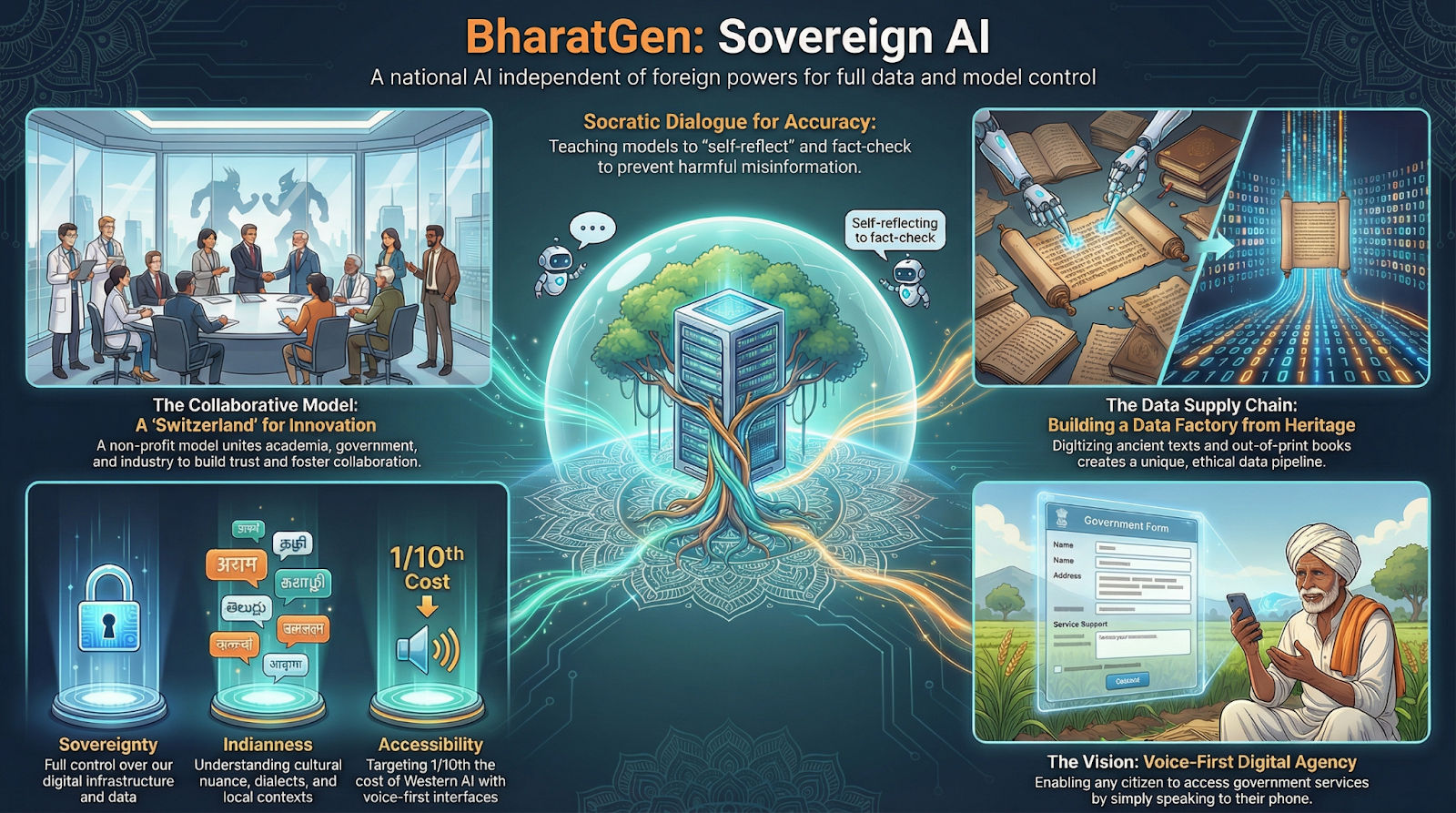
In a world of aggressive corporate moats, BharatGen is doing something radical: operating as a non-profit. Why? Because trust is the ultimate currency in India’s tech ecosystem. By removing the friction of commercial competition, BharatGen has created a “Switzerland” for Indian innovation. We are bringing together the sharpest minds from the IITs, IIITs, and IIMs alongside government bodies and industry leaders.
As Rishi noted, being a good partner means inviting complementary collaborators rather than competing with them. This model allows us to focus on the shared national goal: building AI that serves India first, without the pressure of quarterly earnings.
2. The Three Pillars: Sovereignty, Indianness, Accessibility
BharatGen isn’t building a Western model with a “Hindi skin.” We are building from the ground up on three non-negotiable pillars:
- Sovereignty: Full control over our data and models. India cannot afford to be technologically dependent on foreign "black boxes" for critical infrastructure—much like we wouldn't outsource our energy or defense.
- Indianness: This goes beyond translation. It’s about understanding the nuance of dialects, scripts, and cultural contexts that a model trained primarily on Western datasets will always miss.
- Accessibility: If AI isn't affordable, it isn't useful. Our target? One-tenth the cost of Western AI. We are prioritizing voice-first interfaces to ensure that a farmer in rural Maharashtra has the same level of digital agency as a software engineer in Bengaluru.
3. Solving the Data Scarcity "Factory"
One of the most captivating parts of the discussion was our strategy for the “Data Supply Chain.” You can’t just buy high-quality data for low-resource Indian languages; you have to build the factory to create it.
We are currently collaborating with heritage organizations to digitize out-of-print books and ancient texts. We provide the digitization technology for free, and in return, we gain the right to use that data for model training. This creates a continuous, ethical data pipeline that preserves our heritage while powering our future.
4. Responsible AI: More Than a Checklist
In India, the stakes for AI accuracy are incredibly high. A “hallucination” about a government scheme or a historical fact isn’t just a glitch; it can lead to real-world harm.
We are implementing Socratic Dialogue techniques—teaching models to “self-reflect” before they answer. Our ethical framework includes:
- Rigorous Fact-Checking Modules: Post-training guardrails that catch inaccuracies.
- Bias Mitigation: Constant refinement to ensure fairness across India’s diverse demographic landscape.
- Transparency: We don't just use these methods; we publish them on platforms like arXiv to democratize AI safety research.
5. Efficient Infrastructure: The Sovereign Cloud
To keep costs low, we’ve moved away from global hyperscalers. Instead, we partner with local, sovereign AI-native cloud providers like Mesa AI.
By fine-tuning the network and compute layers specifically for our models, we gain fractional efficiencies that add up to massive savings at scale. This keeps the data within our borders and the costs within our reach.
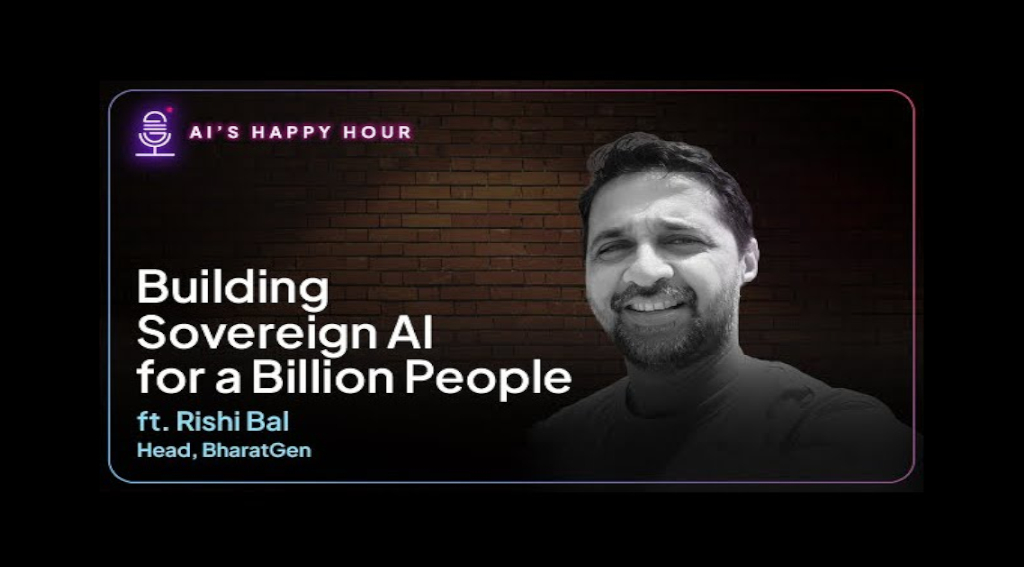


Alt: BharatGen Rishi Bal Podcast: Sovereign AI for India | Neysa AI’s Happy Hour
The Vision: AI as the Ultimate Interface
What does this look like in ten years? Imagine a world where “government websites” don’t exist—only conversational agents.
Instead of navigating a maze of links to file a complaint about a gas connection or a scholarship, you simply speak to your phone. The AI, integrated with Aadhaar and Digital Public Infrastructure (DPI), pre-fills the forms and tracks the progress for you.
BharatGen is proving that India isn’t “late” to the AI race. By focusing on inclusive, federated, and culturally rooted development, we aren’t just joining the race—we’re defining a whole new track.
Source: Times of India