
Buying online in India has become easy. Selling online has not. Before a single sale, a seller has to list each product: a title, the right category from a deep and confusing tree, attributes such as size and colour, variants, a description and a price. The forms are long, they are usually in English, and they assume the seller knows how a marketplace wants things described.
For a small or rural seller, that can be enough to stay offline. For a large seller with thousands of products, it becomes a bottleneck. e-VikrAI was built to remove that step. Its idea fits in a line: list a product in seconds, in your own language.
The demo below starts with a shopkeeper who sells brass and steel kitchenware. His question is a common one: he doesn't speak English, so how can he sell online?

How it works
The seller takes a photo of the product. That is the only input.
From the photo, e-VikrAI fills in the whole catalogue listing:
- A title written for search, using the words Indian buyers actually type.
- The product category, placed in the marketplace's category tree.
- Key attributes, such as size, colour and material, and the product's variants.
- A description and features, written for buyers.
- A suggested price.
It works across the kinds of things Indian sellers list online: clothing and footwear, where size, colour and variants matter most, as well as kitchenware, home goods, handicrafts and packaged food.
The listing can then be translated into Indian languages and read aloud to the seller. Hearing it back means a seller who does not read English, or does not read easily, can still check exactly what is being said about their product before it goes live. That builds trust in the tool and keeps the seller in control.
From six minutes to 15 seconds
Filling in a listing by hand takes a seller about six minutes per product. With e-VikrAI it takes about 15 seconds.
For one product, that is a convenience. For a seller with a catalogue of thousands, or a platform onboarding many new sellers, it changes what is possible. It also lowers the bar for sellers who do not work in English, who are exactly the sellers that online commerce has found hardest to reach.
e-VikrAI was designed with India's public commerce platforms in mind, including the Open Network for Digital Commerce (ONDC) and the Government e-Marketplace (GeM), as well as the large private marketplaces. It also fits schemes such as One District One Product (ODOP), which help local producers sell beyond their district.
The AI model underneath
e-VikrAI runs on IndicVikr-7B-Instruct, a vision language model (VLM) built specifically for Indian e-commerce. A vision language model reads an image and writes about it in natural language, so it can look at a product photo and describe the product the way a catalogue needs.
Indian products are hard for models trained mostly on Western catalogues. A kurta, a steel tiffin box, a brass diya and a packet of regional snacks all need the right names and categories, and often the right words in Hindi or another Indian language. IndicVikr was built with more than 1.4 billion product images spanning more than 10,000 product categories, so that it recognises what Indian sellers actually sell.
Where it was shown
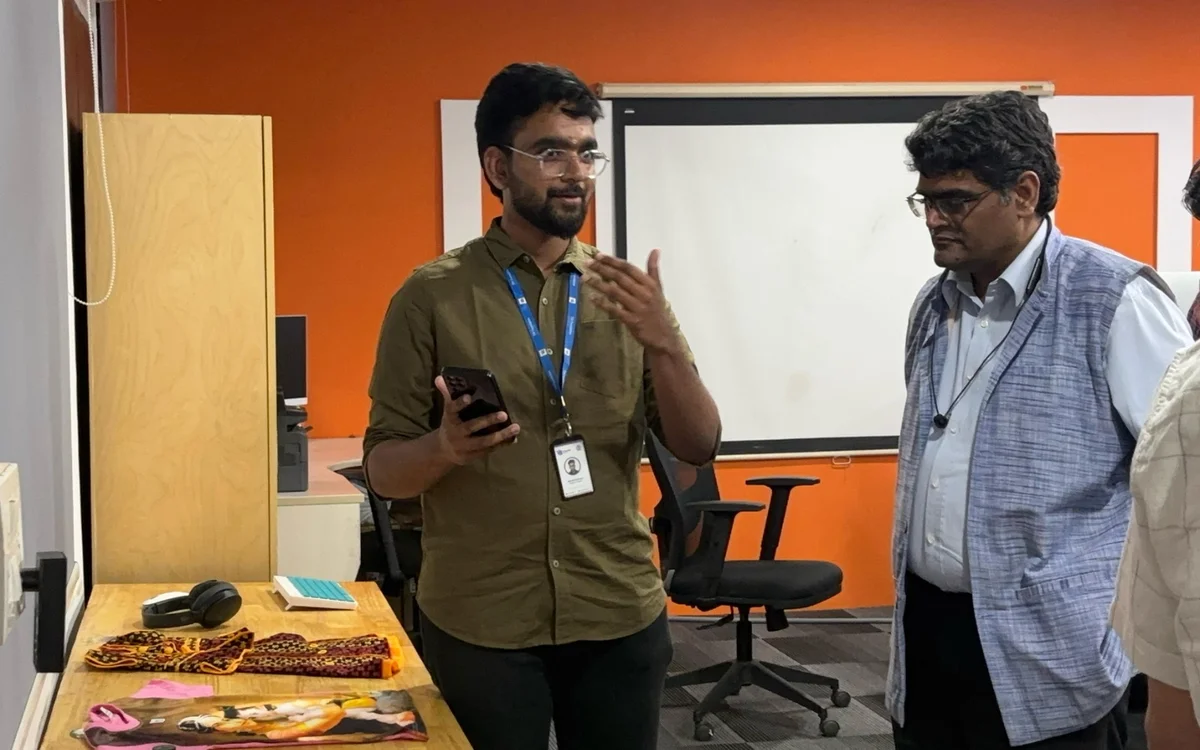
e-VikrAI was one of our first applications to go in front of the public. We showed it at India Mobile Congress 2024 in New Delhi in October, and at the Rising Rajasthan Global Investment Summit in Jaipur in December 2024. That month, IndiaAI named it among six interesting Indian AI models from 2024.
Why it matters
India has millions of small sellers with products worth selling well beyond their own town. Many of the barriers they face online are not about the product at all. They are about paperwork, categories and language.
e-VikrAI showed how much of that a vision language model built for India can take away: one photo in, a complete listing out, in the seller's own language. More on BharatGen's vision language models is on our vision AI models page.
Since this post, BharatGen's vision team has gone on to build Patram, our family of vision language models.


